Monday, April 5, 2021

Review: Leadership Hero Code


In Leadership Hero Code, author Kristen Hemingway asserts that leaders need to evaluate their personal leadership health and the health of their team in order to be more effective. This process is obtainable by using the 7 principles mapped out in this book.  The 3 principles of personal leadership health are Your Energy Bank, Sense of Purpose and Attention to Self-Care.  The 4 principles of team leadership health are Collective Energy, Psychological Safety, Authentic Exchanges, and Vital Conversations.  Each chapter introduces the theory behind the principle as well as practical applications the readers need to execute said principle.  There are many opportunities to reflect and even write down one’s experiences within the pages of this book.  Therefore, it can be utilized as an interactive tool which only enhances the learning experience.


For the seasoned workers, these principles seem simple enough; one should take care of his/her/their personal needs and then go on to create relationships with his/her/their team. What Hemingway does with this book is give the readers a road map.  Leadership Hero Code is the “how” that goes with the “why.”  Most readers understand the theory of work-life balance, but few are able to obtain it (or else books such as this one would not be necessary).  This book is the scaffolding so many people need in order to achieve true effective leadership.  As we begin to climb out of this pandemic and back into normalcy, this might be the perfect opportunity to reevaluate those skills and decide what is needed as new skills meld with the ones society deemed necessary before the COVID-19 lock down.


Kristen Hemingway’s Leadership Hero Code is deceptively simple.  The road map of effective leadership is outlined using layman’s terms, but the hard work of becoming that effective leader rests on the shoulders of the readers.  This blueprint with its 7 principles is easy to understand, easy to use, and applies to anyone who finds him/her/themselves in a leadership role.  This book is recommended for all people who are questioning their capability and efficiency as a manager, officer, boss, principal, or any other term meant to describe a leader.  This book will give the readers the tools they need to reevaluate their skills and practice a few new ones.


Monday, March 29, 2021

Library Wellness Check


Every month I am part of the leadership team meeting at my school, and thankfully, my principal gives me time on the agenda to talk about the library.  A few days before the big meeting, I prepare three talking points: readership, classes in the library, and special projects.  Normally, classes in the library would entail coming in to check out books or receive help with research.  However, my library is limited to Dual Credit virtual classes and classes without SUBs this year due to COVID-19.  It is not ideal, but I also tell myself this is not permanent.  This year is different. It would be easy to complain about my situation.  Instead I choose to focus on the ways I am reaching students.  However, I do think it is important for the administration to know what classes we are covering and how that affects our readership and my special projects.  That is why I also added "time spent monitoring classes" as part of my 6 weeks library usage statistics report.  I just want to make sure we are all on the same page.

In preparing for my March meeting, I decided to concentrate on our databases for the "readership" portion of my talking points.  When I arrived at Summit 4 years ago, I felt that no one was using our databases, and no one wanted help from the librarian.  Spring of my first year, a junior English teacher took and chance and asked for help.  Ms. Washington was my gateway.  Databases were still unpopular, but I was able to show the students how MLA format was included.  Then they became more popular.  Each 6 weeks I would watch my database usage statistics, and the slow growth was frustrating at the time, but I see the gains now.    I tracked database searches for 3 months (Jan - Mar) for 2018, 2019, 2020, & 2021 just to see. Here is the comparison I reported in the March leadership team meeting.


Remember, this is only for January, February and March of each year.  You can see the dip in 2020 due to the COVID-19 shutdown.  Our last day of in person school that year was March 6th.  

I always learn something when I look at the numbers.  For instance, my original statement about no one using databases wasn't exactly true.  If you look at the 2018 numbers, you can clearly see I was able to influence some teachers and students; they were indeed using our resources.  I am pretty excited about the numbers this year, and I hope the usage only goes up from here.  I have decided that slow growth is better than no growth.

If you are also frustrated with an area of your library program, I urge you to look at the numbers.  Find the data.  Sometimes it tells a different story.


Tuesday, February 16, 2021

Review: Because They Marched


This is a book I reviewed a few years back.  It seemed appropriate to revisit it at this time during Black History Month . . . 


Thanks to recent events, voting rights are a controversial topic much like they were in the 1960s.  What is that about history repeating itself?  To see the struggle as it unfolded, one should read Because They Marched: the People’s Campaign for Voting Rights that Changed America.  This book has captured the voting rights struggle in history by matching Russell Freedman’s skilled writing with the powerful black and white photographs found throughout the book.  The main focus of this publication is the previous two years before President Johnson signed the Voting Rights Act of 1965 into law.  However, the author is careful not to talk about this struggle in isolation.  Mr. Freedman easily gives the reader the information he/she needs in order to clearly understand the Civil Rights Movement and how Selma, Alabama was an important piece of the overall outcome during this time in history.  His short chapters and first-hand accounts of the clash between the black and white Americans in Selma, Alabama keeps this book from becoming another sterile, non-fiction account of an important time in history.  

The language is fluid, not clinical, and the reader can easily imagine that a grandfather or great-grandfather is telling this story.  Because They Marched: the People’s Campaign for Voting Rights that Changed America can easily be compared to Freedom Riders: Lewis and Jim Zwerg on the front lines of the Civil Rights Movement (by Anne Bausum) or Martin’s Big Words: the life of Dr. Martin Luther King, Jr. (by Doreen Rappaport and Bryan Collier).  In comparing these tales, the reader will recognize the same storytelling style of a nonfiction event.

This book is organized and written well, and seems to be a current topic of choice. Whether this is recreation reading or research for a class, this book will make the patron's experience with voting rights more stimulating. It is definitely recommended for any personal, school or public library.


Monday, January 11, 2021

Finding Joy amidst the Craziness


Can't say I am sad to see 2020 go . . . although the beginning of 2021 has had a bumpy start.  However, I am an optimist.  So I have decided this WILL be a better year.

In looking back at the first semester of school this year, I can honestly say I love what I do.  This was not an easy start, and this is not a normal year.  I keep telling myself that.  This year will mark my 26th year in education, and without a doubt, this year has been different from all the rest.  I am trying to find the joy in the little things.  That keeps me going.

One of the things I am loving this year are my virtual activity calendars.  It sort of evolved from the activities I posted during the shut down last Spring.  Every day I had a new virtual activity for my students and their families.  It looked something like this . . . 

So, I tweeted out the calendar on Sunday, and then tweet out each activity on their corresponding days.  I did it all with Hootsuite which lets you schedule posts across many platforms.  For me, that is Twitter, Facebook and Instagram.  Creating these calendars was just something fun I liked to do, and it was a way to become familiar with all those free-during-the-pandemic resources.  Then I would know what to recommend if a teacher came to me looking for something to go on his/her/their Canvas page, or if an administrator asked me to share something with the campus.

So at the beginning of this school year, I was struggling with putting some fun back in the library.  I got bogged down in virtual dual credit classes coming to the library, babysitting when a SUB wasn't available, and taking attendance (over and over again) for our office aides. I honestly started questioning my career choices.  Then I remembered how much fun I had planning those virtual activities, and decided to give it another go.  

Here is what that looks like now . . .  


Do many students participate?  Not really.  The library "regulars" found my Canvas page last Spring, and started getting into the activities.  These are the students who participated in the "in person" activities before the pandemic, and they are enjoying the monthly activities I am putting out now.  It's a small, but dedicated audience.  And I am okay with that.  

To see all of my calendars so far, click here.  August and September were nothing special, but I hit my groove in October.

Recently, in a FB group I joined, I had some people question my efforts if the virtual activities did not draw a lot of traffic.  So I simply said these calendars helped me regulate my stress.  When I get caught up in a task that brings me down or stresses me out, I go to these calendars and concentrate on filling out just one or two days.  It is amazing how my outlook turns around when I concentrate on something fun for just a few minutes.  In addition, as stated above, I use these calendars to familiarize myself with certain resources and/or tools. I always want to be ready when a patron asks for help.  So I feel my work is justified when it helps me and my library "regulars."


Trying to get through the school year?  My advice is to find your joy amidst the craziness, and don't let go.

Friday, December 11, 2020

Review: It's All Love by Jenna Ortega


In It’s All Love: Reflections for your Heart and Soul, eighteen year old Jenna Ortega gives the readers a refreshing dose of teen optimism with her anecdotes of the various life lessons she has learned.  It is clear that her family is her main support.  Although she is quick to point out that one’s family of choice is just as important as family by blood, her stories consistently illustrate how a loving family can be crucial to a developing teen.  Although Ms. Ortega is an actor, her stories of boy crushes, family, faith, true friends, and believing in oneself are universal. 


Many teens may not be able to relate to her devastation of being passed over for a role in a movie; however, they will be able to relate to what she has done to overcome that devastation. Those who have read Dr. Honos-Webb’s book, 6 Super Skills of Executive Functioning (New Harbinger, 2020) will see some similarities when it comes to seeking help for depression.  Both Ms. Ortega and the teen subjects in Dr. Honos-Webb’s book describe their struggles in the same way.  They talk about not wanting to seek help thinking they were being too dramatic, or that their problems seemed miniscule compared to others they know.  After seeking help, they all realized that problems are personal and not to be compared to others. With the growing rate of depressed and suicidal teens in today’s society, this message is something they need to hear. 


In addition to depression, there are many other applicable life lessons Ms. Ortega depicts in her book.  She talks about confidence, asking for help, believing in oneself, how to manage stress, and how her faith fits into her hectic life.  She also continues to emphasize how good relationships make one’s life better while bad relationships should be seen as an opportunity to learn. The wisdom exuded in these pages is unexpected from the typical perspective of an eighteen year old. Ms. Ortega is wise beyond her years.


The short stories and fast pace of the book makes this an effortless read. The inconsistent sentence structure does not dilute Ms. Ortega’s passion. What makes this book most relatable is that it is a collection of stories from a teen for other teens.  Ms. Ortega does not talk down to her readers.  She only wants to help. . For these reasons, It’s All Love: Reflections for your Heart and Soul will appeal to reluctant readers as well as those just seeking more positivity in their lives.


Thursday, November 5, 2020

Here We Go Again. The End of Another Grading Period.


Fall is definitely in the air, and so is COVID.  We have teachers and students who have it, and those who are quarantined because of it.  So far the library is COVID free.  That is my big goal for the year - not to be ground zero for the outbreak in our school.  Even after ALL of the English classes paraded through for Yearbook pictures, we are good.  (Hope I just didn't jinx myself.) 

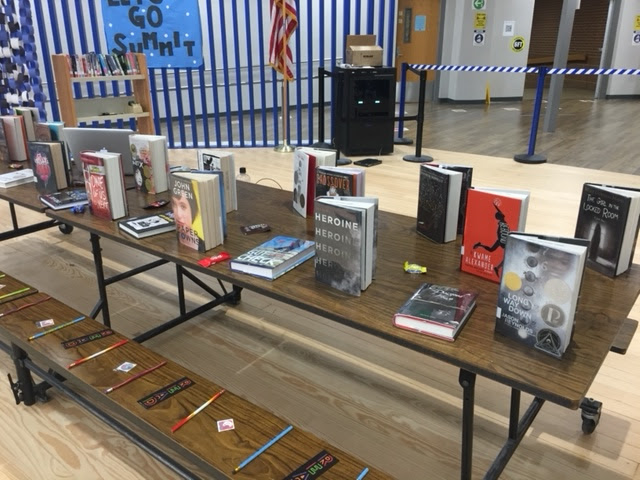
The 2nd six weeks ended on Oct. 30, 2020.  We have opened the library during class only for those who want to check out a book.  We are still not open before school, during lunch or after school.  Thank goodness for those eBooks.  I even tried a "Pop Up Library" in the cafeteria with actual books to try and reach our reading population.  


Some students took advantage of it which made me feel better.  I just hate that my regular library students are either at home virtually learning, or they are in school, but just can't get to the library.  This realization led me to my next project: The Virtual Activities Calendar.

Another way students can engage with the library is by participating in our virtual activities  Here are my October and November calendars.  I am working on December now.  My hope is that even if we have to go remote this winter, I can still push out the calendars (and the eBooks).  I hope we don't shut down again, but it is better to be prepared for the worst as you are hoping for the best.

Here are our library usage statistics for the 2nd Six Weeks of the year.  Enjoy!

Friday, October 23, 2020

Review: The Rebellious Life of Mrs. Rosa Parks


 The Rebellious Life of Mrs. Rosa Parks

By Colbert and Theoharis


The name Rosa Parks conjures up images of her most famous act of defiance, refusing to give up her seat to a white man on a segregated bus in Montgomery, Alabama.  Upon reading “The Rebellious Life of Mrs. Parks,” the readers will see a pattern of rebellion that started when Mrs. Parks was a young girl and never really ended until her death in 2005.  She fought for black people, especially for black women, for over 60 years. Rosa Parks was an activist and an organizer as one of the few women holding an office in the NAACP.  She marched with Dr. Martin Luther King, Jr., and she went to the rallies of Malcolm X.  The bus incident which led to a 2 year bus boycott and the eventual desegregation of public transportation is only one example of her activism.  The full story of Rosa Parks is more traumatic and heart-rendering than the textbook portrayal of a tired seamstress who refused to give up her seat on a bus.  She and her family endured criticism, threatening phone calls, police brutality, and more.  After the famous bus incident, she and her husband were fired from their jobs which led to their eventual move to Detroit.  As much as the readers want to believe racism was exclusive to the Southern states, both Mrs. Parks and her husband experienced bigotry during their time spent in Michigan as well.  Known the world over in contemporary times, she was often overlooked as a leader during her own time because she was a black woman.  Rosa Parks allowed her actions to speak for her during a time when speeches made men famous. 


Authors Jeanne Theoharis and Brandy Colbert have created a thorough tome for readers who truly want to understand Mrs. Parks’ life.  The two-dimensional version most people encounter does not paint an accurate picture of Mrs. Park's hopes, dreams, struggles, heartbreaks, and successes.  The writing style flows seamlessly drawing the readers into her world.  The authors invite you to be a part of the narrative and experience the life of Rosa Parks.  The addition of journal entries in Mrs. Park’s own handwriting and actual photos lend to the authenticity of the stories.  


Verdict: Any library that includes grades 6 - 12 should add “The Rebellious Life of Mrs. Parks'' to its collection.