Thursday, November 5, 2020

Here We Go Again. The End of Another Grading Period.


Fall is definitely in the air, and so is COVID.  We have teachers and students who have it, and those who are quarantined because of it.  So far the library is COVID free.  That is my big goal for the year - not to be ground zero for the outbreak in our school.  Even after ALL of the English classes paraded through for Yearbook pictures, we are good.  (Hope I just didn't jinx myself.) 

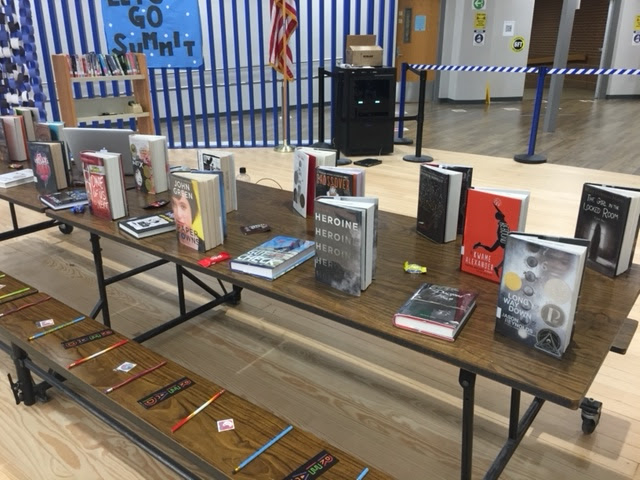
The 2nd six weeks ended on Oct. 30, 2020.  We have opened the library during class only for those who want to check out a book.  We are still not open before school, during lunch or after school.  Thank goodness for those eBooks.  I even tried a "Pop Up Library" in the cafeteria with actual books to try and reach our reading population.  


Some students took advantage of it which made me feel better.  I just hate that my regular library students are either at home virtually learning, or they are in school, but just can't get to the library.  This realization led me to my next project: The Virtual Activities Calendar.

Another way students can engage with the library is by participating in our virtual activities  Here are my October and November calendars.  I am working on December now.  My hope is that even if we have to go remote this winter, I can still push out the calendars (and the eBooks).  I hope we don't shut down again, but it is better to be prepared for the worst as you are hoping for the best.

Here are our library usage statistics for the 2nd Six Weeks of the year.  Enjoy!

Friday, October 23, 2020

Review: The Rebellious Life of Mrs. Rosa Parks


 The Rebellious Life of Mrs. Rosa Parks

By Colbert and Theoharis


The name Rosa Parks conjures up images of her most famous act of defiance, refusing to give up her seat to a white man on a segregated bus in Montgomery, Alabama.  Upon reading “The Rebellious Life of Mrs. Parks,” the readers will see a pattern of rebellion that started when Mrs. Parks was a young girl and never really ended until her death in 2005.  She fought for black people, especially for black women, for over 60 years. Rosa Parks was an activist and an organizer as one of the few women holding an office in the NAACP.  She marched with Dr. Martin Luther King, Jr., and she went to the rallies of Malcolm X.  The bus incident which led to a 2 year bus boycott and the eventual desegregation of public transportation is only one example of her activism.  The full story of Rosa Parks is more traumatic and heart-rendering than the textbook portrayal of a tired seamstress who refused to give up her seat on a bus.  She and her family endured criticism, threatening phone calls, police brutality, and more.  After the famous bus incident, she and her husband were fired from their jobs which led to their eventual move to Detroit.  As much as the readers want to believe racism was exclusive to the Southern states, both Mrs. Parks and her husband experienced bigotry during their time spent in Michigan as well.  Known the world over in contemporary times, she was often overlooked as a leader during her own time because she was a black woman.  Rosa Parks allowed her actions to speak for her during a time when speeches made men famous. 


Authors Jeanne Theoharis and Brandy Colbert have created a thorough tome for readers who truly want to understand Mrs. Parks’ life.  The two-dimensional version most people encounter does not paint an accurate picture of Mrs. Park's hopes, dreams, struggles, heartbreaks, and successes.  The writing style flows seamlessly drawing the readers into her world.  The authors invite you to be a part of the narrative and experience the life of Rosa Parks.  The addition of journal entries in Mrs. Park’s own handwriting and actual photos lend to the authenticity of the stories.  


Verdict: Any library that includes grades 6 - 12 should add “The Rebellious Life of Mrs. Parks'' to its collection.


Monday, September 28, 2020

Review: Depression: Insights and Tips for Teenagers


Depression: Insights and Tips for Teenagers

by Dr. Cognevich


Depressed teenagers are often misjudged as being dramatic, sensitive, moody or attention seeking. Some teens ignore their symptoms thinking these feelings will pass.  Many adults ignore signs of teen depression believing such signs are normal growing pains. According to Depression: Insights and Tips for Teenagers, the second book in the “Empowering You” series, young adults have legitimate feelings that need to be addressed. Teens should not dismiss their feelings as insignificant, and adults should strive to understand what is happening before the pain of depression becomes more destructive. Author Dr. Cognevich writes a compelling blueprint both teens and supportive adults can follow in order to identify, understand, and manage depression.  The anecdotes of her own struggles and that of the many teens with which she works help the readers understand they are not alone. Her practical strategies are easily understood and will help these young adults better their own situations. With each chapter, the author reveals a new skill that should be added to their personal toolboxes.  From recognizing physical changes that act as triggers to stress inventories, teens are learning to cope with their depression one tool at a time.


This book is similar in format to Jean Rawitt’s book,  Volunteering: Insights and Tips for Teenagers (Rowman & Littlefield, 2020), which is the first book in the “Empowering You” series.  Both authors advise teens without condescension. Their narrative styles and use of actual teen stories will entice the targeted audience to read more. Where they differ is in their subject matter.  The focus of Volunteering is to show the readers how to live fulfilling lives by giving back to their communities; whereas Depression is about how to live fulfilling lives by recognizing and managing depression .  After reading Dr. Cognevich’s book, young adults will be well equipped with the stamina and tenacity needed to process their depression and navigate their way through any situation. This book is timely and full of practical resources for high school students.


Verdict:  Both high school and public libraries will have a better nonfiction collection with the purchase of this book, Depression: Insights and Tips for Teenagers.


Tuesday, September 22, 2020

The First 6 Weeks is Over? What Did I Do?

Wow!  Our first grading period ended on Friday, September 18, 2020.  There are a lot of procedures that changed due to COVID-19.  In the beginning, the changes seemed insurmountable.  Now, they are still unbelievable, but the staff is adjusting and going home exhausted every night.  For those of you not in education, you might ask, "What changed?"  Well, here you go.

Lesson plans, attendance, and grading practices have changed.  How students come into the building in the morning has changed.  How students leave the building has changed.  Then there is the addition of face masks to the student dress code, dealing with multiple seating charts, and sanitizing EVERY seat in between classes.  In addition, teachers are starting to get sick, and some have been asked to quarantine.  The substitute teachers are not coming.  So any free time teachers might have (where they could create lesson plans or grade papers) is now dedicated to watching another class.  So, yeah, education has changed.

While adjusting to these new changes, I still had to run a library . . . sort of.  Our district came up with some guidelines which make sense and keeps everyone safe.  Of course it means the library is a bit too quiet for me.  Since my library is being used as a place for the dual credit students, I realized pretty quickly that my usual students couldn't come in to check out books.  So I invested in 2 eBook platforms, Junior Library Guild and Teen Book Cloud.  Those usage statistics is what carried the book check out this first 6 weeks.  I just started letting students reserve books in Destiny Discover.  Then we pull their requests from the shelves and deliver them to the students.  So those statistics should show up during the next reporting period.

So, what did I do this first six weeks?  Here are my library usage statistics.  Hopefully they speak for themselves.  Enjoy!


Monday, August 31, 2020

40 Book Pledge: Virtual Edition

 Last year was my first year to organize a book club around Donalyn Miller's 40 Book Challenge.  To read all about my adventures last year, see previous blog posts "40 Book Pledge," "Half Way through the 40 Book Pledge, " and "End of the 40 Book Pledge."

Due to the current Coronavirus pandemic we are experiencing, I decided to take the 40 Book Pledge virtual.  The meetings are asynchronous. I decided that many of their actual classes were using the synchronous format already.  So in lieu of face-to-face meetings or video chats, I am posting a discussion once or twice a month on our district chosen platform, Microsoft TEAMs.  I created a 40 Book Pledge class, and invited students and faculty to join using a TEAMs code.  I am planning to post on a Tuesday, and the participants have the rest of that week to respond.  They can participate by responding to my post or by making comments on someone else's posts.  I arranged it this way on purpose because I want the virtual club to be low-key and not stressful.  Plus I want it to be a comfortable space where books can be discussed on their time.

I worked on the transformation of this club from in-person to virtual this past summer.  Here is what I created . . . Bitmoji style. (Just a side note on the whole Bitmoji craze.  I find that the Bitmoji rooms are my happy place.  This is a way for me to unwind and do something creative while I am processing whatever needs to be processed, which - let's face it - was a lot these past 6 months.  I'm pretty sure I don't even care if the students like the Bitmoji thing because I do.  Sometimes you have to do a little something just for you.  Thank you for coming to my Ted Talk. 😁)

Back to the topic at hand . . . here is my 40 Book Pledge Bitmoji which has ALL of the information my patrons need to join and participate. 


The books sitting next to me on the couch are my works cited.  Everything on the chalkboard opens to a Google doc explaining that topic.  Then each of the genre stickers opens to a genre room with book recommendations from our actual library. Now that I have purchased 2 new eBook platforms, I will probably change some of the books in these genre rooms to reflect the ones they can find on JLG Stream or Teen Book Cloud.

Let's talk about recruiting.  Last year I introduced the club during my library orientation classes.  This year I was still putting my library back together from the summer renovation.  The library is BEAUTIFUL, but it has taken more time than I care to admit putting everything back together.  So no classes.  Therefore, I sent out the Bitmoji information to the faculty this week, and I will send an additional email next week to our ELAR teachers so they can add the link to their Canvas courses. I am also planning to reach out individually to all the participants from last year. 

I just posted a "Welcome to the Club" discussion where the students/staff will introduce themselves and talk about their favorite books or genres.  Then our first "meeting" will be Sept. 22nd.  We'll see how this goes.

Have a fantastic day, and be safe out there.


Tuesday, August 18, 2020

Review: Six Super-Skills for Executive Functioning


Six Super-Skills for Executive Functioning 

by Dr. Honos-Web


At its essence, executive functioning is the ability to plan life goals and carry them to fruition.  Psychologist Dr. Lara Honos-Web has created a clear and stimulating guide for teens to help them sharpen those skills directly related to executive functioning regardless of the teens’ abilities or situations.  The six super-skills discussed in this book are finding gifts, setting goals, chunking, boosting motivation, managing mood, and finding focus. Each chapter is organized into small segments allowing the readers to digest the information. Dr. Honos-Web uses authentic science to explain the skills and then adds real-word examples of high school students applying these skills to their everyday lives.  In addition, each chapter stresses the importance of positive self-talk, using technology to help achieve goals instead of being a distraction, and using said skills instead of drugs or alcohol to alleviate stress; examples of how this can be done are also included.  Dr. Honos-Web often encourages the readers to journal their feelings throughout the book.  In this respect, Six Super-Skills for Executive Functioning is much like another teen self-help book, This Moment is Your Life (Dial Books) by Miriam Gates.  Both guides encourage teens to manage their stress in healthy ways, give examples, and ask the readers to journal their progress.


These super skills are relevant in today’s off-center world.  Any readers, no matter their age, will find something helpful within the pages of this book. Dr. Honos-Web seamlessly weaves science and actual examples into her narrative without talking down to her audience.  The chapters are succinct yet seem to cover a lot of information.  Readers who are interested in living their best lives should not hesitate to pick up a copy of this book.  All public and high school libraries will have a better collection if Six Super-Skills for Executive Functioning is part of their nonfiction repertoire.    


Verdict: Because of its applicable subject matter and general appeal to both teens and adults, Six Super-Skills for Executive Functioning by Dr. Lara Honos-Web is recommended as a first choice for both public and high school libraries.


Thursday, July 2, 2020

Review: Imaginary Borders by Xiuntezcatl Martinez


Xiuhtezcatl Martinez has been fighting for climate change since the age of six.  He states that his generation has more tools available to them with the presence of social media.   Therefore, they understand the problems of the world.  It is not that his generation does not care, it is that they find it hard to engage when no real solutions are presented.  In his short novel, Imaginary Borders, Mr. Martinez’s focal points are the connection between many global crises and climate change, what he is doing to help, and what the readers can do when they are ready to engage.


Mr. Martinez illustrates his argument using many statistics, historical examples and his own experiences.  The population destroying the earth’s climate is not the population having to live with the consequences. People of Color (POC) in poorer neighborhoods, or even poorer countries, are usually the ones whose homes are flooded or burned during storms which are coming more frequently due to climate change.  According to current trends, by the end of the century climate catastrophes will be 64 times worse “which would mean more than half of California burning every year.”  Mr. Martinez also makes the connections between climate change, national budget issues,  immigration, and even wars.  Solve the problem with climate change, and it could alleviate the others.  Mr. Martinez is calling on others in his generation to help redefine the movement with their diverse talents.  As the author states, “It’s not about changing the world - it’s about building it together.” 


With this book, the author is addressing today’s young adults.  The content reflects issues in society today; it is heart-felt and to the point.  In addition, the novel is short and meaningful which will appeal to reluctant readers. Therefore, Imaginary Borders is an essential purchase for any high school or public library.